We are a masonry conservation practice. We work on Grade I and II listed buildings, ecclesiastical structures, heritage infrastructure, and historic homes — removing harmful materials, repairing original fabric, and restoring buildings to the way they were meant to work.
Every project starts with understanding what the building needs. We intervene only where necessary, with materials that are compatible with the original construction. The result is work that lasts and fabric that is protected for the long term.
Existing mortars are analysed before any repointing specification is produced. Trial mixes developed, test panels prepared and approved. Evidence-based specification every time — never a default mix.
IBIX Trilogy 28 micro-abrasive, owned and operated, and Thermatech superheated steam. Thermatech is the system used by English Heritage, the National Trust, and the Commonwealth War Graves Commission for cleaning sensitive historic fabric.
Lime mortar repair, stone indenting and brick replacement, consolidation of eroded and friable fabric. All repair materials softer, more permeable, and more flexible than the parent masonry.
Method statements, mortar analysis reports, photographic records, and completion reports on every project. The paperwork that protects you, your client, and the building.
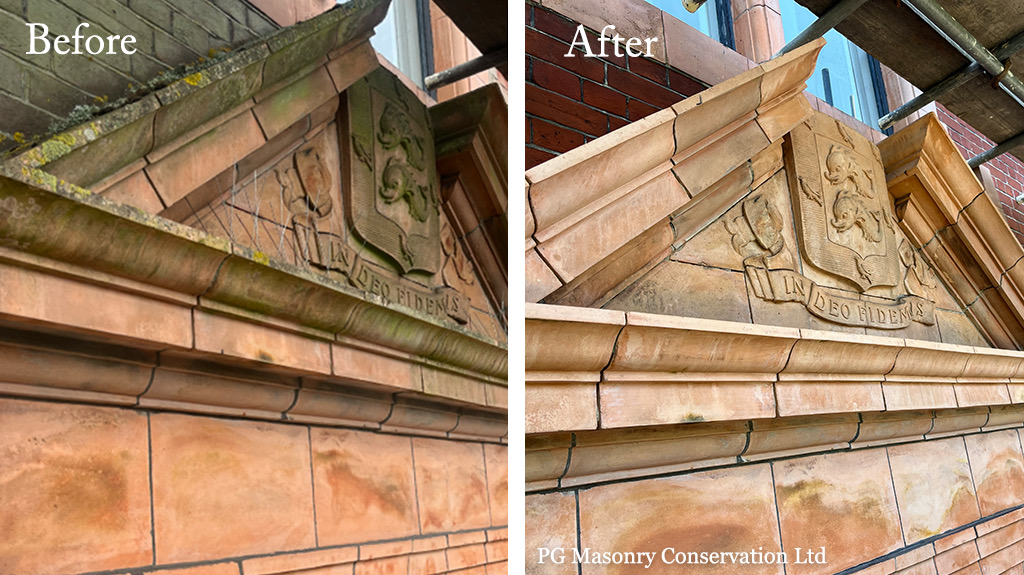
Thermatech superheated steam cleaning of the Victorian terracotta facade and boundary wall, with ammonium carbonate poultice trials to remove sulphation from the carved scallop details — full photographic condition record and trial panel sign-off throughout.
Read the case studyWe work with conservation architects, heritage surveyors, ecclesiastical bodies, main contractors, and homeowners in conservation areas — anyone who needs masonry conservation work done to a written standard, with the documentation to prove it.
Available without the overhead national contractors carry, wherever the project is.
The masonry conservation market has two ends: large national contractors — expensive and slow to mobilise — and a long tail of skilled sole traders with no written systems. PG Masonry Conservation Ltd occupies the gap.
Our guarantee: if a cost isn't in your written quote, it will never appear on your invoice without your sign-off first. Any uncertain item is priced separately and only carried out on your written instruction — never absorbed quietly into the final bill.
Whether you are a conservation architect specifying a subcontractor, a surveyor needing a specialist, or a homeowner with a listed building — get in touch and we will talk it through.
Contact usEvery job run personally, start to finish — availability is limited
The full range of masonry conservation work — from condition survey through to cleaning, repair, and project management.
Mortar specification is always evidence-based. Existing mortars are analysed before any repointing specification is produced — we never assume a standard mix or apply a default solution.
Cleaning is specified only where soiling is actively harmful to the substrate or where it is needed to enable accurate assessment. We use the mildest effective method for the specific substrate and soiling type.
All repair materials are softer, more permeable, and more flexible than the parent masonry. Repair is carried out to arrest deterioration and stabilise the fabric — not to restore a new appearance.
Cement render and masonry paint trap moisture inside Victorian and Edwardian brickwork — causing the damp problems that no amount of interior treatment will resolve. We remove what should not be there and replace it with breathable lime.
A condition survey is the right starting point for any conservation project. Understanding what is there, why it is deteriorating, and what is actually needed prevents unnecessary works and ensures specification is targeted and proportionate.
For larger conservation programmes, PG Masonry Conservation Ltd provides subcontract project management — coordinating masonry works within a wider programme, with documentation, standards compliance, and quality control handled throughout.
Not sure what your building needs? Get in touch — we will talk it through honestly, with no obligation.
Contact usOne person doing the work personally, with a full written record of everything that happens to your building.
I am Remi Greer, founder and director of PG Masonry Conservation Ltd. I have spent years working directly on historic buildings — learning the fabric, the materials, and what it takes to care for them properly. That hands-on foundation is what PG is built on.
The practice focuses on Grade I and II listed buildings, ecclesiastical structures, and conservation-area properties. I set it up because I wanted to do conservation work the right way — with the right methods, the right materials, and the written documentation that protects clients, buildings, and the work itself.
My approach is simple: understand what a building needs before touching it, then do only what is necessary to address that. Not the most impressive intervention. Not the most visible. Just the right one.
That means lime mortars specified from analysis, not habit. Cleaning methods matched to the substrate, not the equipment available. Repairs compatible with the original fabric — softer, more permeable, more flexible than what sits next to them.
It is the same approach whether the building is a Grade I listed cathedral or an ordinary Victorian terrace. Historic fabric is irreplaceable. The decisions made about it today affect everyone who comes after.
On every project, PG Masonry provides full written documentation — condition survey, mortar analysis, method statement, photographic record, and signed completion report. Not every firm treats that as standard. It should be.
West Dean College of Arts & Conservation — Building Conservation Masterclass: Masonry Cleaning. Certificate No. BCM/3104
IBIX Trilogy 28 micro-abrasive system (owned and operated) · Thermatech superheated steam
£10m Public & Employers Liability
Policy IP26ATRAD00028221104
If you have a project to discuss — or just want to understand what is happening to your building — get in touch. I am always happy to have an honest conversation.
Get in touchWhy the right materials matter — and what happens when they do not.
Victorian and Edwardian buildings were designed to manage moisture in a specific way. Understanding that system — and working with it rather than against it — is what masonry conservation is about.
Before the 20th century, almost all buildings in Britain were built with soft, porous materials — hand-made brick, natural stone, lime mortar, and lime render. These materials were not waterproof. They were breathable.
The system worked like this: rain hits the wall, the surface absorbs a small amount of moisture, and as conditions dry the moisture evaporates back out. The wall gets wet and dries out — consistently, harmlessly, over and over again for a hundred years or more.
Lime mortar plays a specific role in this. It is softer and more permeable than the brick or stone it sits between. When thermal movement or settlement creates stress in the wall, the mortar absorbs it — cracking slowly and sacrificially rather than allowing the harder, more valuable masonry to fracture. The mortar is designed to be replaced. The brick is designed to last.
In the 20th century, cement became the standard building material. It is harder, denser, and far less permeable than lime. Applied to a Victorian wall — as mortar, render, or paint — it disrupts the breathable system the building was designed around.
Moisture that would previously have evaporated freely is now trapped. It migrates inward through the building fabric, carrying dissolved salts that crystallise as the moisture tries to escape. Those salt crystals expand as they form and the pressure breaks down the softer historic brick from within — a process called spalling. The visible result is damp patches on interior walls, crumbling brick faces, and paint or render that perpetually peels and fails.
The solution most people reach for — another coat of paint, another layer of render, a damp-proof injection — treats the symptom and makes the underlying problem worse. The only lasting fix is to remove what is trapping the moisture and restore the building's ability to breathe.
Masonry conservation starts from a different place: understand the building before intervening, and intervene only where necessary.
That means analysing the existing mortars before specifying replacements. Testing cleaning methods on small areas before treating a whole elevation. Choosing repair materials that are compatible with the original construction — softer, more permeable, more flexible — rather than the hardest or most convenient option available.
The goal is not to make the building look new. It is to arrest the deterioration that is happening, remove the materials causing harm, and leave the building in a condition where it can continue to function as it was intended for another hundred years.
The principle of minimum intervention runs through everything we do. It comes from the Venice Charter of 1964 — the foundational international document on conservation practice.
In practice it means: do what is necessary. Nothing more. The original fabric of a historic building is irreplaceable — every intervention, however well-intentioned, carries a risk of unintended damage or irreversible change. The conservative approach is not timid. It is the most responsible position available.
It also means being honest about what cleaning, repointing, or repair can and cannot achieve. We will not promise results the work cannot deliver, and we will not recommend works the building does not need.
If your property is listed or sits within a conservation area, additional considerations apply to any external works. Listed Building Consent may be required before certain works can proceed — including changes to mortar, render, or surface coatings. Carrying out works without consent is a criminal offence with no time limit.
PG Masonry Conservation Ltd can prepare documentation suitable for listed building consent applications and pre-application discussions with conservation officers. If you are unsure whether your project requires consent, get in touch — we can advise.
Yes. The type of mortar used matters — a lot. Cement-based mortars trap moisture in old brickwork and cause long-term damage, whereas lime mortars allow it to escape. Many general builders are unaware of this or ignore it.
We analyse the existing mortar — binder type, aggregate, colour, and grading — and develop trial mixes until we have a close match. Test panels are prepared on the building and reviewed before any full works proceed.
It gets priced separately and never actioned without your written sign-off first. If we find a hidden condition that wasn't in the original scope — common once scaffold is up and render comes off — we will tell you what it is, what it costs to put right, and wait for your instruction. It never just appears on the final invoice.
Get in touch for an honest conversation. We will tell you what we can see, what we think it means, and what — if anything — needs to be done about it.
Contact usWhether you have a specific project in mind, a building you are concerned about, or just want to understand what is going on with your masonry — we are happy to talk it through.